
Central Laboratory, Mitra S. K. Private Limited
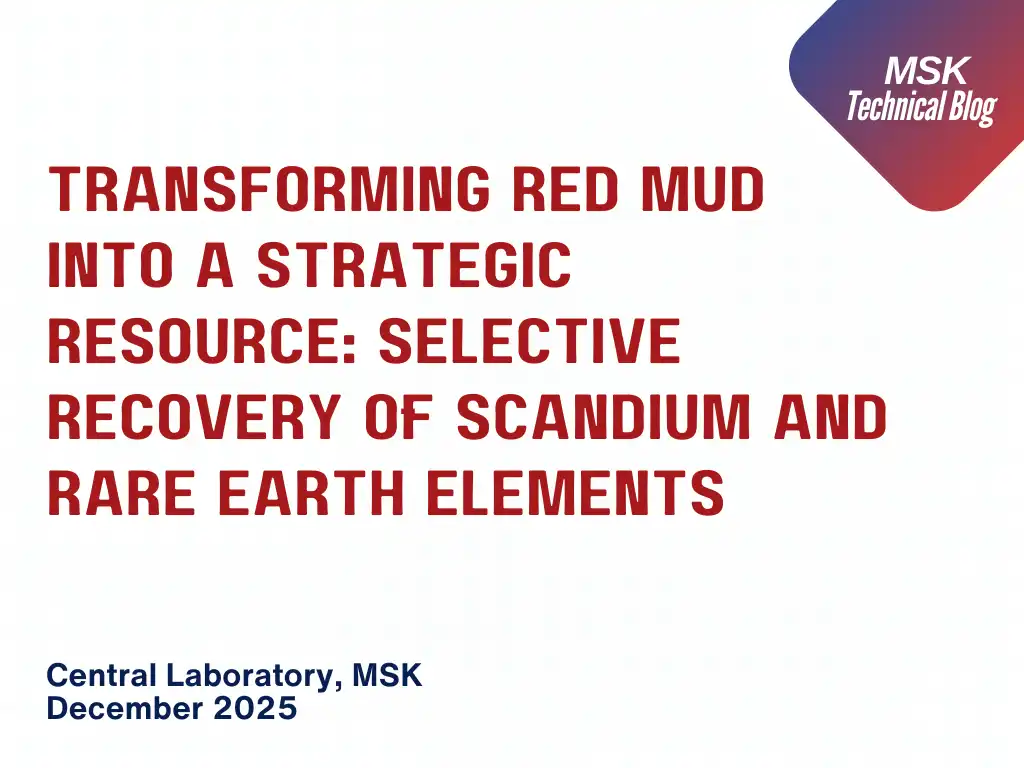
Red mud, the solid residue generated during the Bayer process of alumina production, represents one of the largest industrial waste streams in the world. With more than 180 million tonnes produced annually, its disposal poses long-term environmental and economic challenges. Highly alkaline in nature and rich in iron oxides, silica, alumina, and titanium, red mud is often stored in vast impoundments, creating risks of soil contamination, groundwater pollution, and catastrophic dam failures. Yet behind these challenges lies a hidden opportunity. Red mud also contains strategically important trace metals, particularly Scandium (Sc) and Rare Earth Elements (REEs)—key materials for clean energy, aerospace, electronics, and advanced alloys. The primary difficulty has always been the selective recovery of these trace metals from complex and stable oxide matrices dominated by iron and aluminum. Recent advances in controlled ammonium sulfate roasting followed by aqueous leaching have opened a promising and scalable pathway to unlock this potential in a sustainable manner.
The key innovation is the controlled roasting of red mud with ammonium sulfate followed by hot water leaching. Below 500 °C, ammonium sulfate decomposes to produce SO₃, which selectively converts scandium and rare earth oxides into water-soluble sulfates. As the temperature rises to 500–710 °C, the unstable iron and aluminum sulfates decompose back into insoluble oxides. In summary, Sc and REEs remain in soluble sulfate form, while Fe and Al stay insoluble—this thermal selectivity is the true engine behind the entire process.
Table 1. Roasting stages and dominant reactions during (NH₄)₂SO₄ processing
| Stage | Temperature (°C) | Duration (min) | Objective / Dominant Reaction |
| Ramp1 | 100 → 500 | 30 | Decomposition of (NH₄)₂SO₄; formation of SO₃ atmosphere. |
| Hold1 | 500 | 30 | Sulfation of Sc₂O₃, RE₂O₃, Fe₂O₃, and Al₂O₃; formation of mixed sulfates. |
| Ramp2 | 500 → 710 | 30 | Gradual desulfation of unstable Fe and Al sulfates. |
| Hold2 | 710 | 30 | Complete desulfation of Fe₂(SO₄)₃ and Al₂(SO₄)₃; stabilization of Sc and RE sulfates. |
The roasted material is leached using hot deionized water at 80 °C for 2 hours with an optimised solid–liquid ratio. Under these mild conditions, scandium and rare earth sulfates dissolve readily, while iron and aluminum oxides remain in the solid residue. This enables clean separation of strategic metals without using aggressive acids, making the process both efficient and environmentally benign.
Varying the ammonium sulfate to red mud ratio revealed a clear optimum for selective metal recovery. As the ratio increased from 0.75:1 to 1.25:1, scandium extraction rose sharply from 19 to 33 ppm, while iron dissolution remained extremely low (<0.12%). At higher sulfate addition (1.5:1), no further improvement in scandium recovery was observed, and minor aluminum co-dissolution began. Light REEs showed a slight decreasing trend at higher dosages, confirming scandium-selective enrichment. The optimum operating condition is 1.25:1, delivering maximum scandium recovery with minimal iron contamination.
Table 2. Dissolution behavior of Fe₂O₃, Al₂O₃, ΣLREEs, and Sc as a function of the (NH₄)₂SO₄ : red mud ratio, illustrating the effect of sulfate dosage on selective sulfation and subsequent leaching efficiency
| Sample | (NH₄)₂SO₄ : RM Ratio | Fe₂O₃ (%) | Al₂O₃ (%) | ΣLREE (ppm) | Sc (ppm) | Key Observation |
| RM-3 | 0.75 : 1 | 0.023 | 1.32 | 218.5 | 19 | Lower sulfate addition results in limited Sc activation but high selectivity; Fe and Al remain stable. |
| RM-4 | 1.0 : 1 | 0.049 | 2.68 | 216.5 | 28 | Optimum onset of Sc and REE sulfation; Fe₂O₃ dissolution still negligible (<0.05%). |
| RM-5 | 1.25 : 1 | 0.114 | 3.97 | 212.6 | 33 | Highest Sc extraction achieved; Fe co-dissolution remains below 0.12%, confirming selective leaching. |
| RM-6 | 1.5 : 1 | 0.143 | 4.72 | 207.4 | 32 | Oversulfation leads to minor Al co-dissolution; Fe remains largely in solid residue. |
Beyond critical metal recovery, the process delivers a second major benefit—iron enrichment of the solid residue. The Fe₂O₃ content increases from ~51% to ~72% after mild NaOH washing, transforming the residue into a potential iron-making feedstock, construction-grade pigment material, and magnetic precursor. As a result, the process generates two high-value product streams: (1) Sc–REE-rich leach solution and (2) Iron-enriched solid residue.
The controlled ammonium sulfate roasting–leaching approach marks a major breakthrough in sustainable metallurgy. It enables selective recovery of scandium and rare earth elements, suppresses iron and aluminum co-dissolution, and simultaneously delivers iron-enriched solid residues for further use. In essence, red mud is no longer just an industrial waste—it is a future-ready strategic resource.


Chief Operation, FAMD, Tata Steel Limited..

Sr. General Manager,, Emirates Trading Agency L.L.C..

Mines Manager, Hindustan Zinc Limited, a Vedanta Company.

General Manager, Stevin Rock L.L.C..

Executive Vice President (Works),, DCW Limited.

AVP – Coal Quality & Sales Compliance Head,, PT Indo Tambangraya Megah Tbk (BANPU).
Laboratory Head, MMX.

Shipping Administrator, Mount Gibson Iron Limited.

Senior Director – Asia Pacific Iron Ore Sales,, Cliffs Natural Resources Pty Ltd..

Member, Compass Group (India) Pvt. Ltd.
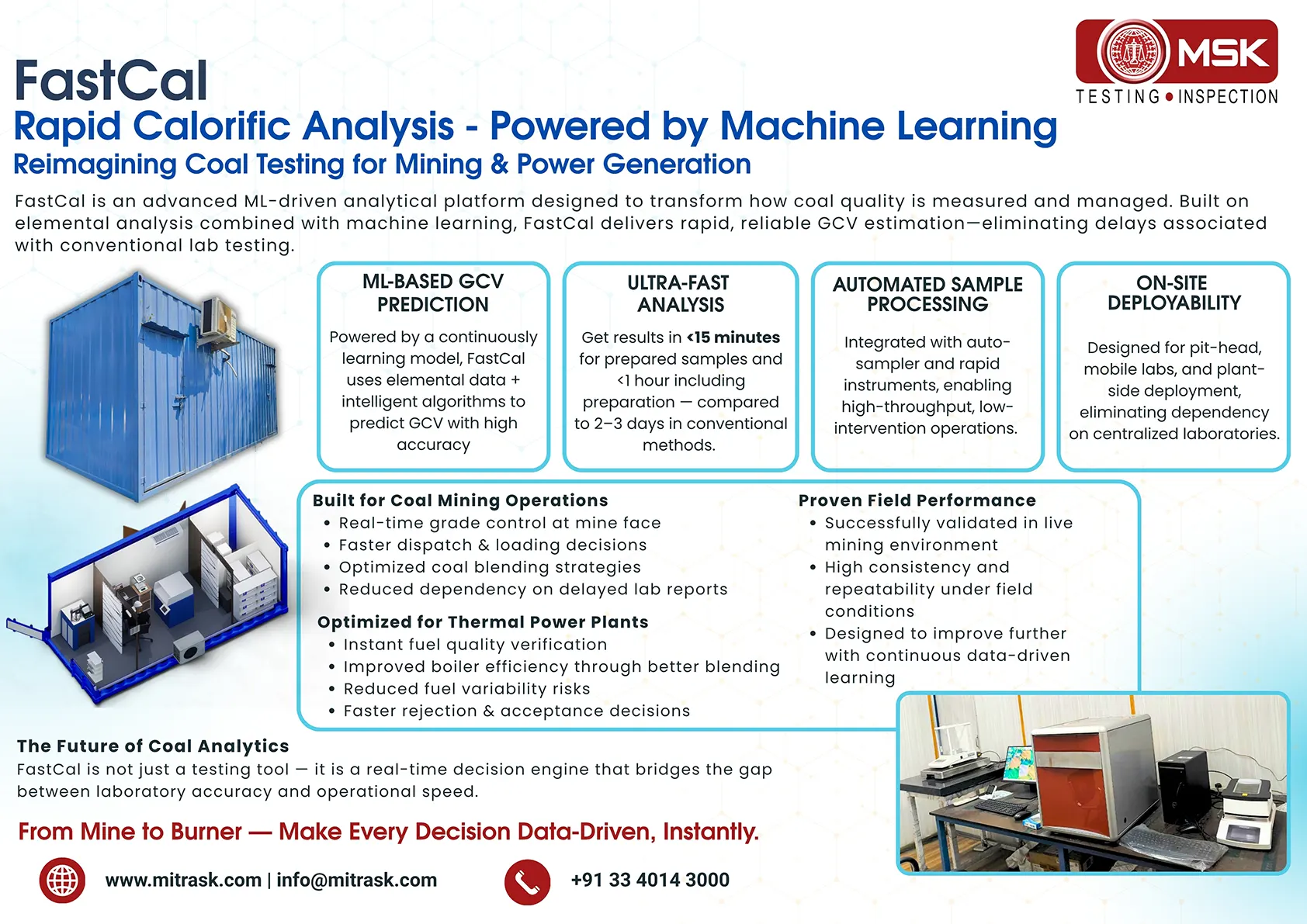
Posted on May 27 2026 By Mitra S.K ADMIN
Read More
Posted on April 23 2026 By Mitra S.K ADMIN
Posted on February 19 2026 By Mitra S.K ADMIN
Posted on February 19 2026 By Mitra S.K ADMIN
Posted on January 16 2026 By Mitra S.K ADMIN
Posted on January 16 2026 By Mitra S.K ADMIN
Posted on January 16 2026 By Mitra S.K ADMIN
Posted on January 16 2026 By Mitra S.K ADMIN
Posted on January 16 2026 By Mitra S.K ADMIN
Posted on December 16 2025 By Mitra S.K ADMIN
Posted on December 16 2025 By Mitra S.K ADMIN
Posted on December 16 2025 By Mitra S.K ADMIN
Posted on December 11 2025 By Mitra S.K ADMIN
![Estimating Cobalt by UV-Vis Spectroscopy: The [CoCl?]²? Acetone Method](https://mitrask.com/uploads/blogs/1778156837Estimating%20Cobalt.webp)
Posted on December 04 2025 By Mitra S.K ADMIN
Posted on December 04 2025 By Mitra S.K ADMIN
Posted on November 12 2025 By Mitra S.K ADMIN

Posted on September 23 2025 By Mitra S.K ADMIN
Posted on August 01 2025 By Mitra S.K ADMIN
Posted on July 25 2025 By Mitra S.K ADMIN
Posted on July 18 2025 By Mitra S.K ADMIN
Posted on July 01 2025 By Mitra S.K ADMIN
Posted on May 22 2025 By Mitra S.K ADMIN

Posted on January 24 2025 By Mitra S.K ADMIN

Posted on January 24 2025 By Mitra S.K ADMIN
Posted on December 31 2024 By Mitra S.K ADMIN
Posted on December 31 2024 By Mitra S.K ADMIN
Posted on December 31 2024 By Mitra S.K ADMIN
Posted on December 31 2024 By Mitra S.K ADMIN
Posted on December 31 2024 By Mitra S.K ADMIN
Posted on December 03 2024 By Mitra S.K ADMIN

Posted on October 17 2024 By Mitra S.K ADMIN
Posted on October 04 2024 By Mitra S.K ADMIN
Posted on September 13 2024 By Mitra S.K ADMIN
Posted on August 27 2024 By Mitra S.K ADMIN
Posted on August 23 2024 By Mitra S.K ADMIN
Posted on June 27 2024 By Mitra S.K ADMIN
Posted on June 22 2024 By Mitra S.K ADMIN
Posted on June 15 2024 By Mitra S.K ADMIN
Posted on May 24 2024 By Mitra S.K ADMIN
Posted on May 17 2024 By Mitra S.K ADMIN

Posted on May 09 2024 By Mitra S.K ADMIN
Posted on April 20 2024 By Mitra S.K ADMIN
Posted on April 13 2024 By Mitra S.K ADMIN

Posted on April 30 2024 By Mitra S.K ADMIN

Posted on April 29 2024 By Mitra S.K ADMIN
Posted on December 30 2023 By Mitra S.K ADMIN
Posted on December 30 2023 By Mitra S.K ADMIN
Posted on December 30 2023 By Mitra S.K ADMIN
Posted on December 27 2023 By Mitra S.K ADMIN
Posted on December 27 2023 By Mitra S.K ADMIN
Posted on December 27 2023 By Mitra S.K ADMIN
Posted on December 27 2023 By Mitra S.K ADMIN
Posted on December 27 2023 By Mitra S.K ADMIN
Posted on December 27 2023 By Mitra S.K ADMIN
Posted on December 27 2023 By Mitra S.K ADMIN
Posted on December 26 2023 By Mitra S.K ADMIN
Posted on April 05 2022 By Mitra S.K ADMIN
Posted on April 06 2022 By Mitra S.K ADMIN
Posted on April 06 2022 By Mitra S.K ADMIN
Posted on April 06 2022 By Mitra S.K ADMIN
Posted on April 06 2022 By Mitra S.K ADMIN
Posted on April 06 2022 By Mitra S.K ADMIN
Posted on April 06 2022 By Mitra S.K ADMIN
Posted on April 06 2022 By Mitra S.K ADMIN
Posted on April 06 2022 By Mitra S.K ADMIN
Posted on April 06 2022 By Mitra S.K ADMIN
Posted on April 06 2022 By Mitra S.K ADMIN
Posted on April 06 2022 By Mitra S.K ADMIN
Posted on April 06 2022 By Mitra S.K ADMIN
Posted on November 28 2022 By Mitra S.K ADMIN
Posted on April 06 2022 By Mitra S.K ADMIN
Posted on April 06 2022 By Mitra S.K ADMIN
Posted on April 06 2022 By Mitra S.K ADMIN
Posted on November 28 2022 By Mitra S.K ADMIN
Posted on June 14 2022 By Mitra S.K ADMIN